

Day trips
- Sagres
- Silves and Monchique
- Costa Vicentina and Aljezur
TOP 10 LAGOS ATTRACTIONS AND THINGS TO DO
THE MUST-SEE TOURIST ATTRACTIONS AND TOP ACTIVITIES IN LAGOS, ALGARVE, PORTUGAL
Ponta da Piedade

This headland with a series of magnificent rock formations is one of the highlights of the entire Algarve region, and therefore the most visited sight in Lagos. From the clifftop, from the scenic boardwalk or by the sea at the bottom of a long staircase, you have breathtaking views of the natural wonder, sculpted for thousands of years by the wind and the waves. For close-up views, many go on kayak or boat tours, which allow access to hidden caves and grottoes. This is also a stunning sunset spot, when the light gives the ocher rocks an extra yellow or golden tone.
St. Anthony Church and Lagos Museum

A plain church from outside hides a rich interior that’s considered one of Portugal’s finest examples of gilded woodwork. The golden carvings mix with blue-and-white tile panels and a beautifully painted ceiling, while in the former sacristy is a museum dedicated to the art, history and culture of Lagos. Its collection of pieces goes back thousands of years, from the city’s first Celtic and Phoenician settlers to the 20th century (it includes prehistoric standing stones, Roman mosaics and tiles).
Slave Market

When Prince Henry the Navigator sent his men to map the coast of Africa in the hope of finding a maritime route to Asia, he ended up opening the way to European exploration and global trade. At first, the traded goods were spices, silk and gold, but after their colonization of the “new world,” Europeans realized that the slave trade would also be profitable. The Portuguese took Africans to Lagos and sold them to other European empires or sent them to Brazil. The building where these transactions took place is now a small museum, with displays in Portuguese and English explaining the trade routes, how the slaves were taken across the Atlantic in appalling conditions, how there were slave uprisings in as early as the 1500s, and how Lagos grew as a major port.
Lagos Castle

When Lagos became the capital of the Algarve region, a castle was built as the governor’s residence. It was connected to the town walls (whose origins go back to Roman times), and was defended by the Ponta da Bandeira fortress in front. Only a tiny section of the walls and the castle still stand. They’ve been restored over the years, and a gateway between two watchtowers (known as “São Gonçalo Gate”) is one of the entrances to the Old Town. What’s left of the castle became a hospital and isn’t open as a tourist attraction, but you may admire a Manueline (Portuguese Gothic) window from outside. It’s said that it was from this window that King Sebastião spoke to the assembled nobility in 1578, before joining Portuguese, Spanish, German and Dutch troops on a disastrous crusade to Christianize North Africa (he ended up killed in El-Ksar el Kebir in Morocco). The landscaped area around the castle has a statue of Gil Eanes, the local explorer who was the first European to navigate past Cape Bojador, a major breakthrough in discovering a maritime route to the East.
Ponta da Bandeira Fortress
The port of Lagos was protected by two major fortresses in the 16th and 17th centuries, and this was one of them. The other was completely destroyed by the great earthquake of 1755, but Ponta da Bandeira was soon restored. It preserves a small chapel covered in 17th-century tiles, and shows temporary and permanent exhibitions related to the history of Lagos. From the top, visitors can admire a view over the neighboring beaches.
Hiking in the Algarve
Set out to explore the countless trails and footpaths of the Algarve. Enjoy unforgettable walking routes and discover the region’s true natural character and geological richness, which extend far beyond the magnificent sea cliffs and coastal escarpments. As you venture inland, you will be surprised by the diversity of the landscape at every step, and welcomed warmly by the local communities. Each of the many marked routes offers its own unique features, ensuring a singular experience for every visitor.
To guide your journey, consult the Pedestrian Routes Guide, which provides detailed information on the various itineraries found throughout the Algarve. Explore themed walking routes along the coast, in the barrocal region, and in the Algarve mountains.
Whichever route you choose, you will always have the opportunity to observe an exceptionally rich natural environment. For bird‑watching enthusiasts—especially those interested in migratory species—the mountain trails are not to be missed. Wetland areas are also an excellent option, such as the Alvor Estuary near Portimão or the Ria Formosa, stretching from Loulé to Tavira.
For those seeking more demanding challenges, we recommend the trails in the Monchique mountains, Espinhaço de Cão, and Caldeirão, which offer varying levels of difficulty. Coastal routes are equally striking, crossing deserted beaches and dramatic cliffs.
Follow the Cork Route to discover breathtaking landscapes and learn how one of the Algarve’s most emblematic products is harvested and transformed, shaped by the knowledge and traditions of local communities.
Natural parks are also privileged areas for hiking. Consider visiting the Southwest Alentejo and Vicentine Coast Natural Park, traversed by the Rota Vicentina, or explore the Via Algarviana, which crosses the entire interior of the Algarve. You may also visit the Castro Marim and Vila Real de Santo António Marshland Nature Reserve, where you will find remarkable trails in peaceful areas of dense vegetation.
Set out on foot and feel the essence of the Algarve.
Guide to Algarve’s Walking Trails
An immense Algarve to discover!
The Algarve’s Walking Trails Guide was developed by Portugal’s national tourism authority, Turismo de Portugal.
Cycling Routes
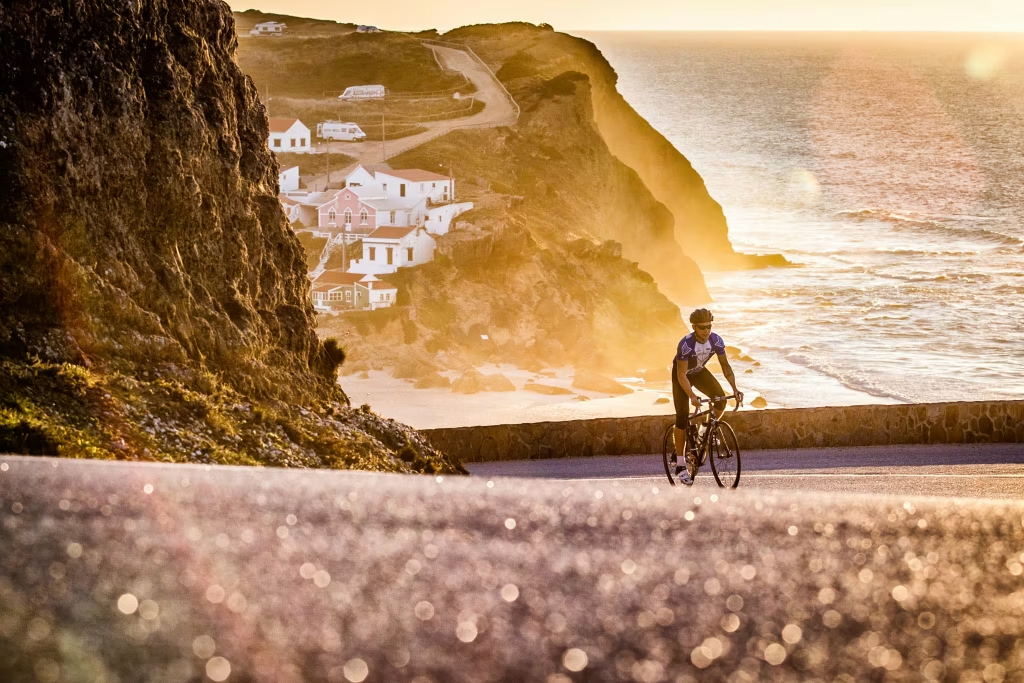
With more than 300 days of radiant sunshine each year, Portugal’s Algarve has become a coveted destination for travelers who prefer to experience a region from the saddle of a bicycle. At its heart lies the Costa Vicentina Nature Park, a protected stretch of coastline where rolling hills meet the Atlantic, cliffs drop into turquoise waters, and secluded beaches feel like private invitations reserved for those who venture beyond the ordinary.
For cyclists seeking either performance or pleasure, the Algarve offers routes that feel crafted with intention—smooth coastal roads for long, elegant rides, quiet inland lanes scented with climbs surrounded by endogenous trees, and panoramic viewpoints that elevate every journey. This is cycling at its most luxurious: unhurried, sunlit, and deeply connected to the landscape.
This guide contains details cycling routes, designed especially to give cycling enthusiasts a more active way to explore the region.
The routes take you along country and municipal roads, and dirt or compacted gravel tracks, so they are not technically difficult and are suitable for touring or trekking bikes and for outings.
Circular routes, where you start and finish in the same place, were created across all of the Algarve’s municipalities, to give you the chance to visit various places of interest in each municipality.
These routes were then used as the basis for a point-to-point route that takes you from one end of the region to the other through the transitional “barrocal” area between the coastline and the uplands. Starting in Vila Real de Santo António (at the same place where the EuroVelo/ Algarve Ecovia route begins) and ending in Aljezur, it covers a distance of 222 km and serves as a complement to the already existing routes, namely the EuroVelo 1 or Algarve Coastal Ecovia, the Vicentine Route, the Via Algarviana and the GR22 (these last two being geared more towards mountain biking).
Four different difficulty levels were established for these routes – easy, intermediate, difficult and very difficult – based on the physical exertion needed for each one depending on its length and metres climbed.
Level 1: Easy
Level 2: Intermediate
Level 3: Difficult
Level 4: Very difficult
As you cycle these routes you will have the chance to become acquainted with little towns and villages across the Algarve. These are places that have managed to preserve their traditions and customs, where you can see at first hand all of their cultural, historical and natural riches and, above all, meet the friendly folk who live there.
Enjoy your rides!
You can find the routes for Western Algarve (Barlavento) in the Tourism of Portugal website here, or explore the routes of Algarve here.
You can also find my favorites routes here (departing from Lagos or Portimão).
photos credits:
- Mercado dos escravos – https://pt.wikipedia.org/wiki/Mercado_de_Escravos
- Igreja de Santo António – lagosportugaltourism.com
- ponta da piedade – lagosportugaltourism.com
- Castelo de Lagos – https://www.feriasemportugal.com/castelo-dos-governadores-lagos